1922–1933
The origins
From the tent camp of a Milanese Fascist group to Paolo Vietti-Violi's colony
The name Sciesopoli joins two words: tendopoli, the tent camp of the squadristi, members of the Fascist action squads, and Sciesa, the name of the Milanese Fascist ward group that founded the colony. A colony, colonia in Italian, was a holiday home where city children spent weeks in the healthy air of the mountains or the sea. The group, led by Jenner Mataloni, had named itself after Amatore Sciesa, a Milanese commoner sentenced to death by the Austrians in 1851. According to tradition, Sciesa refused to name his companions, answering in Milanese dialect “Tiremm innanz”, let’s keep going. The Sciesa group made that motto the title of its newsletter and a watchword.
The colony was dedicated to Emilio Tonoli and Cesare Melloni, two young squadristi of the group who died on 4 August 1922 in the assault on the offices of the socialist daily “Avanti!”. In 1928 the group’s newsletter called it “the most beautiful monument” raised to their memory. Sciesopoli was thus born at once as a work of care for children and as a party monument.
The tent camp and the wooden pavilions
The idea dates back to March 1922: at a squadristi bivouac in Via Senato, in Milan, Tonoli proposed a summer tent camp to his companions; it was held in Val Solda, and Mataloni called it Sciesopoli. From 1924 to 1926 a “little Sciesopoli” for the group’s Balilla boys, the children enrolled in the Fascist youth organization, was held in Bobbio, near Mount Penice.
In May 1927 the Sciesa group decided to give the colony “a fixed, worthy, permanent home”. With the support of Armando Reggiani, the podestà (under Fascism, the government-appointed head of the municipality), it bought four thousand square metres of land in Selvino at the edge of a pine wood, and the engineer Regondi proposed a building of asbestos cement, cheap and quick to build. In the summer of 1927 the first hundred Balilla boys arrived.
In 1928 the central building took Tonoli’s name and a new pavilion Melloni’s. That summer there were more than three hundred Balilla boys, in three sessions, together with thirty war orphans and thirty children of Italian emigrants. In 1930 the “Corriere della Sera” reported that for five years the group had been trying out four-week sessions, judged “more than sufficient” for each course of treatment.
The group’s chronicles describe days run like a barracks. In the morning the children lined up “in a square around the flagpole” for the flag-raising and the prayer for Italy, then did gymnastics “bare-chested in the first sunlight”. Mountain walks became “tactical” exercises, afternoons were for work in the fields, and there were sentries at night too. These are accounts from 1927 and 1928, written by the Sciesa group for its own propaganda.
Vietti-Violi’s colony
To replace the wooden pavilions, the Sciesa group turned to Paolo Vietti-Violi, an architect working in Milan who specialized in sports facilities and had already worked on the group’s Milanese headquarters. The 2015 decree dates to 1929 the founding of a Società Immobiliare Selvino, a property company created to turn the temporary structures into a real building. The design dates from 1932, the year of Vietti-Violi’s drawings, already titled “Progetto Sciesopoli della Fondazione Tonoli e Melloni”, and of the June resolution that allocated the funds.
Working with Vietti-Violi was the Hungarian architect András Benkő, of Jewish origin. In 1939, under the racial laws, he was struck off the register of architects in Milan: after that, the sources consulted say nothing more about him.
The owner was a new body, the Fondazione Tonoli e Melloni, recognized as an ente morale, a non-profit body with legal personality, by a royal decree of 20 April 1933 and chaired by Mataloni: formally, then, the colony did not belong to the party. The complex, registered to the property company, passed to the Foundation in 1934 through a donation that the 2015 decree considers “probably only formal”: the Foundation’s sign already appears on the façade in the film of the inauguration. Its statute said it acted “outside and in addition to” the group’s welfare work, but its aims were partisan: besides health stays in mountain or seaside air for poor children, scholarships for young people “belonging to needy Fascist families” and birth bonuses for mothers “lawfully married to Fascists”. The marble plaques in the entrance hall record who paid for the building: the Sciesa group with 300,000 lire, the City and the Province of Milan, the Cassa di Risparmio, the Banca Commerciale, the Credito Italiano and eighty-six “soci perpetui”, life members, the first of whom is Mussolini.
The first pavilion, for the general services, was inaugurated on Sunday 11 June 1933. Despite a thunderstorm, more than 1,500 members of the Sciesa group came up to Selvino, with many dignitaries. Mataloni “symbolically” handed the colony over to the prefect of Milan; then came the flag-raising, twenty-one shots from a small cannon and the Fascist anthem “Giovinezza”. Mussolini was not there, but he had been the first to subscribe to the Foundation. The Luce newsreel presented the colony as a work “for the children of the people”.
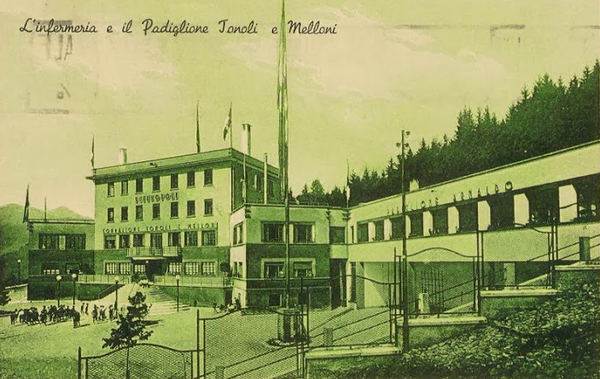
The pavilion has four floors above a base: the entrance hall, the dining hall, two dormitories and, at the top, the director’s apartment with a large terrace for sun cures. The façade is symmetrical, with a semicircular flight of steps and a balcony projecting on the first floor over the “ceremonial square”, as Vietti-Violi called it: the balcony was the podium for official speeches, a recurring feature of the regime’s architecture. Next to it stood the old asbestos-cement building, and the rest of the colony was still a building site. “The building inaugurated yesterday is therefore only one part of ‘Sciesopoli’”, the “Corriere della Sera” wrote the next day.
The regime for the People. In the valley of Selvino the Milanese group Sciesa has dedicated to the Fascist [fallen] Tonoli and Melloni the first pavilion of “Sciesopoli”, an Alpine colony for the children of the people.
Il regime per il Popolo. Nella conca di Selvino il gruppo milanese Sciesa ha dedicato ai [caduti] fascisti Tonoli e Melloni il primo padiglione della “Sciesopoli”, Colonia alpina per i bimbi del popolo.
It is a new work of charity that we wanted, with a will as hard as the rock we quarried from the mountain, to build the summer home of the children of our healthy, disciplined, hard-working and generous people.
È una nuova opera di bene che abbiamo voluto, con la volontà dura come la roccia che dalla montagna abbiamo estratta, per costruire la casa estiva dei figli del nostro popolo sano, disciplinato, laborioso e generoso.
Images
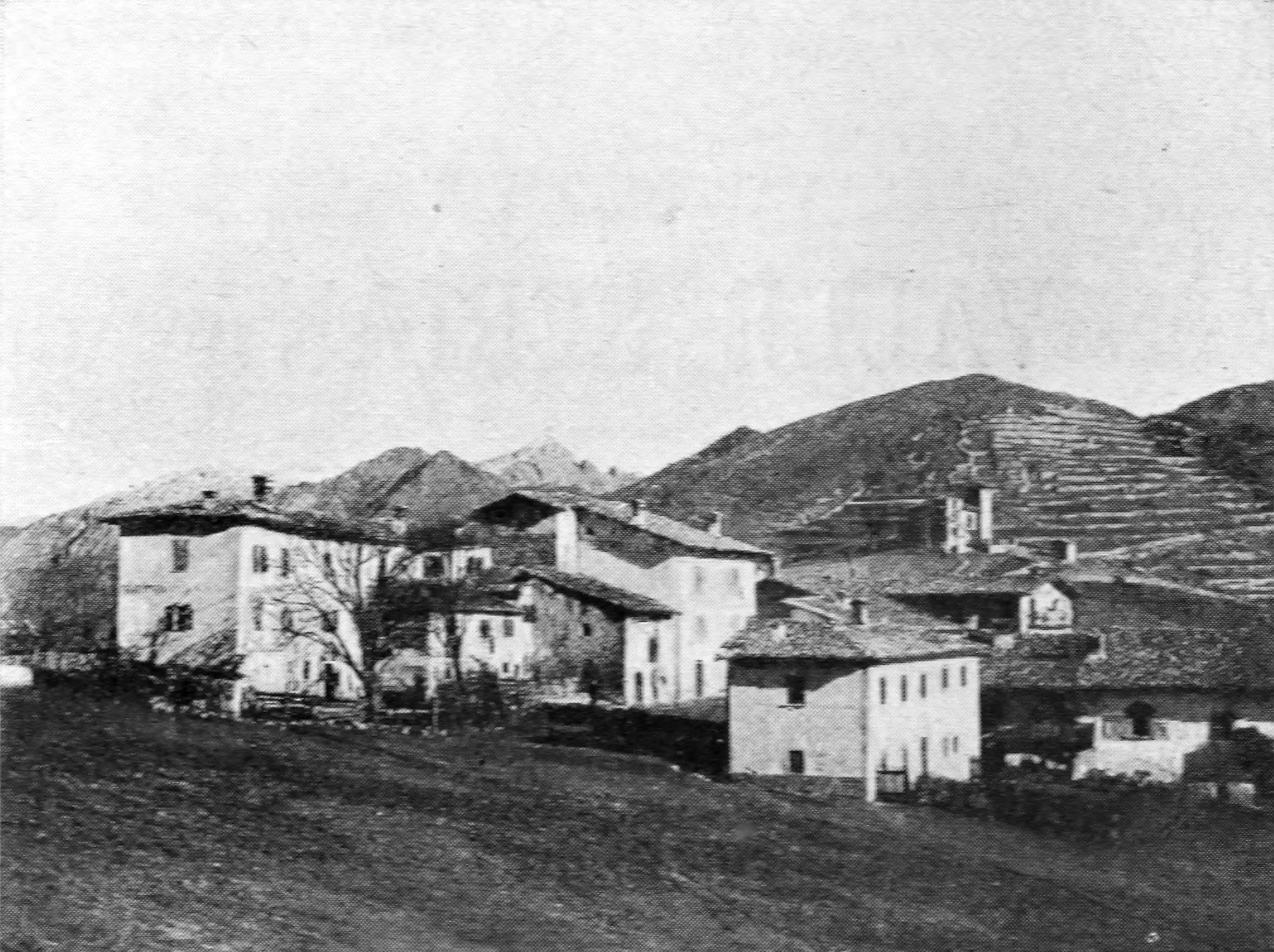
Selvino in 1900. Guide Lampugnani, «Bergamo e sue valli…». Wikimedia Commons, pubblico dominio 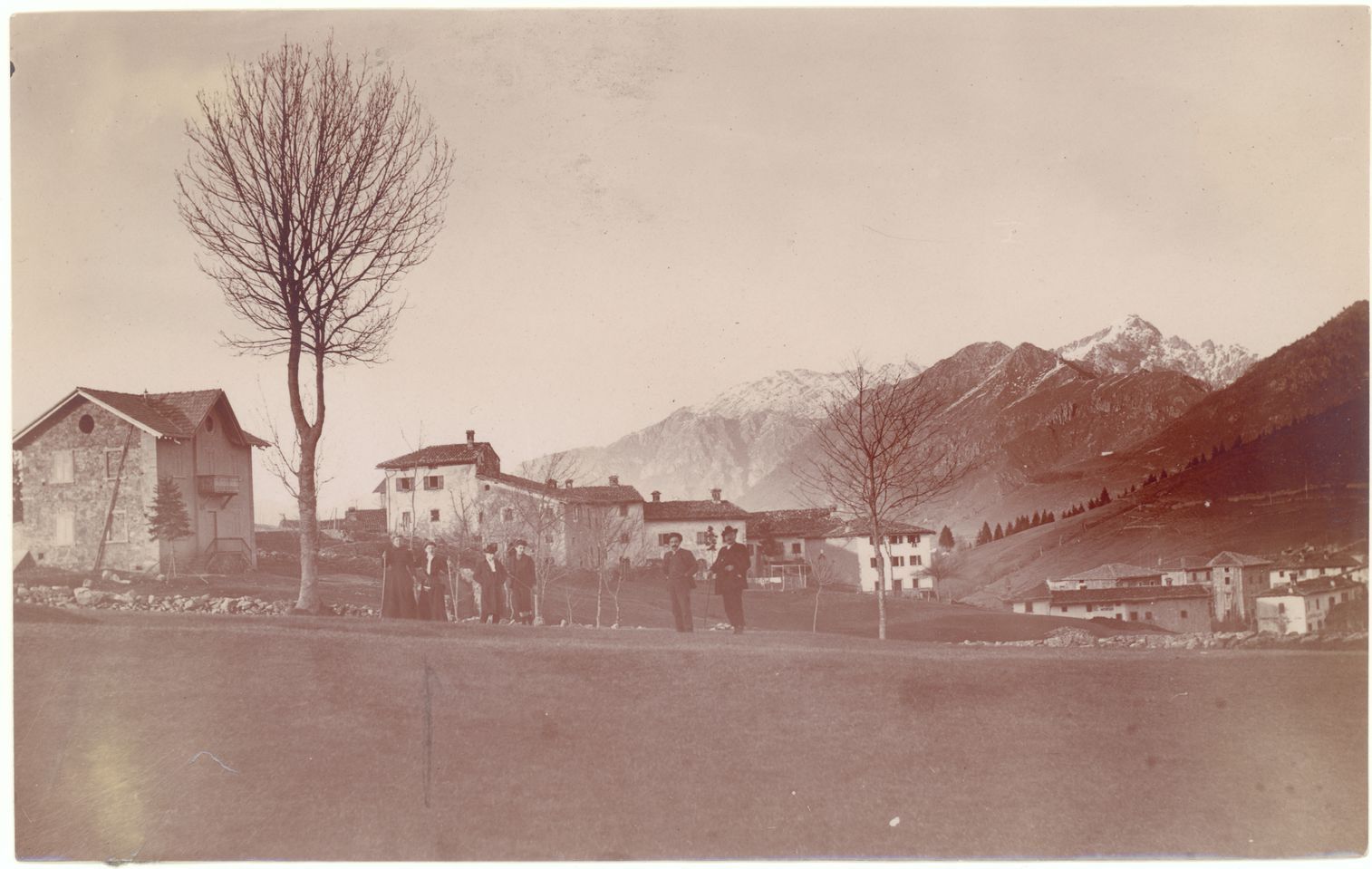
View of Selvino, about 1904–1920. Emilio Sommariva (?), Biblioteca Nazionale Braidense, Milano 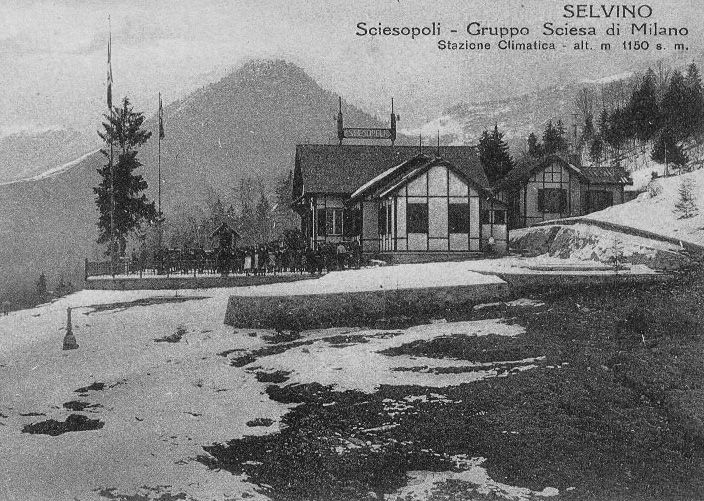
Sciesopoli with its wooden pavilions, postcard of the late 1920s. Archivio del Comune di Selvino 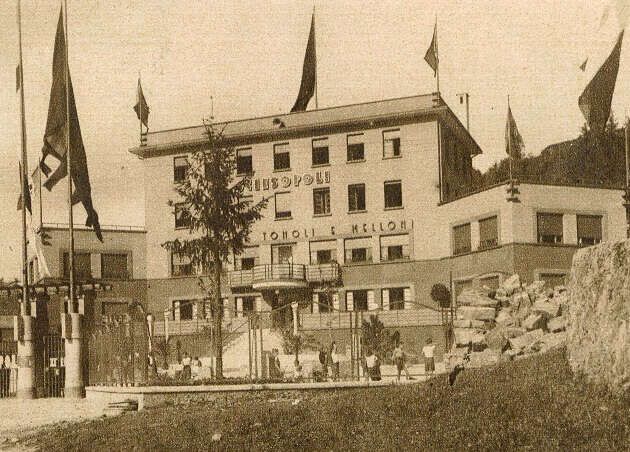
The central pavilion just after its opening, June 1933. Collezione B. Pasinelli – sciesopoli.com
Archive films
- Inauguration of the pavilion of the Sciesopoli colony in Selvino
Archivio Storico Luce, Giornale Luce B0285 · June 1933 · 1 min 35 s
Newsreel made for the regime's propaganda.
A video loads only when you press “Watch here”: from then on YouTube receives data about your visit, as explained on the Privacy page.
Key dates
- March 1922
- Emilio Tonoli proposes a summer tent camp; Jenner Mataloni names it “Sciesopoli” (Ribolletti 2019, p. 72)
- 4 August 1922
- Tonoli and Cesare Melloni die in the squadristi's assault on the offices of the “Avanti!” (Ribolletti 2019, pp. 64–66)
- 1924–1926
- The “little Sciesopoli” for the group's Balilla boys is held in Bobbio (Ribolletti 2019, pp. 96–98)
- summer 1927
- First season in Selvino, in pavilions of wood and asbestos cement (Ribolletti 2019, p. 99; 2015 decree)
- 20 April 1933
- Royal decree no. 417 recognizes the Fondazione Tonoli e Melloni, based in Milan, as an ente morale, a non-profit body with legal personality (Gazzetta Ufficiale no. 114 of 16 May 1933; Ribolletti 2019, p. 75)
- 11 June 1933
- Inauguration of the first masonry pavilion of the colony (Ribolletti 2019, pp. 104–106)
People
- Amatore Sciesa, Milanese commoner sentenced to death by the Austrians in 1851; the Fascist group took his name (Ribolletti 2019, p. 38)
- Jenner Mataloni, leader of the Fascist ward group “Sciesa” and president of the Fondazione Tonoli e Melloni (Ribolletti 2019, pp. 72, 75)
- Emilio Tonoli and Cesare Melloni, squadristi of the “Sciesa” group who died in 1922; the colony is dedicated to them (Ribolletti 2019, pp. 64–66, 72)
- Paolo Vietti-Violi, architect (1882–1965), designer of the colony's masonry buildings (2015 decree)
- András Benkő, Hungarian architect who worked on the design; in 1939 he was struck off the register under the racial laws (Pirazzoli 2024, pp. 261, 265)
Sources
- Segretariato regionale MiBACT per la Lombardia, decreto di dichiarazione dell'interesse culturale della «Ex Colonia Montana Sciesopoli», 25 novembre 2015, relazione storico-artistica.
- S. Ribolletti, «Con la volontà dura come la roccia». Sciesopoli, una «colonia alpina per i bimbi del popolo» nell'Italia fascista, RomaTrE-Press, 2019.
- E. Pirazzoli, «L'orizzonte dopo la catastrofe. Sciesopoli da colonia fascista a centro per giovani profughi ebrei, e oltre», in_bo, 15/19, 2024.
- Regio decreto 20 aprile 1933, n. 417, nella Gazzetta Ufficiale n. 114 del 16 maggio 1933.
Further reading
From 1934 to 1987 the former colony had a single owner, a Milanese welfare body. The other bodies leased it, ran it or sent children there, without ever owning it.
Collecting memories
We are collecting memories, photographs and documents from people who lived or worked in the former colony in Selvino, to tell its whole story.